 Granular NPK fertilizers are widely used in modern agriculture because they supply nitrogen, phosphorus, and potassium in balanced ratios. These essential nutrients support vegetative growth, root development, flowering, fruit formation, crop yield, and overall plant quality. Manufacturing a reliable granular NPK fertilizer requires carefully calculated formulations, suitable raw materials, controlled granulation conditions, and effective quality-control procedures.
The production process begins with selecting raw materials according to the desired NPK grade. Common nitrogen sources include urea, ammonium sulfate, ammonium nitrate, and ammonium phosphates. Phosphorus may be supplied by monoammonium phosphate, diammonium phosphate, or other phosphate-based materials. Potassium chloride and potassium sulfate are frequently used as potassium sources. Fillers, binders, conditioners, micronutrients, anticaking agents, and coating materials may also be included to improve granulation, stability, nutrient balance, and storage performance.
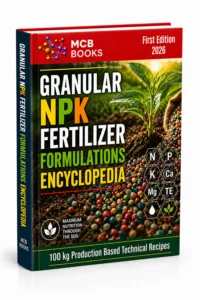
Before production starts, the required nutrient percentages must be calculated accurately. Formulations may be developed for standard grades such as NPK 15-15-15, NPK 20-10-10, NPK 12-12-17, NPK 10-20-20, and NPK 8-24-24. Crop-specific products may also contain magnesium, sulfur, iron, zinc, manganese, boron, or other micronutrients. The GRANULAR NPK FERTILIZER FORMULATIONS ENCYCLOPEDIA provides practical technical information for developing different fertilizer grades and understanding the function of each ingredient.
During manufacturing, raw materials are first inspected, weighed, and prepared. Large particles may need to be crushed, while fine powders should be screened to obtain a more uniform feed. The prepared materials are then mixed to achieve consistent nutrient distribution. The blended material enters a granulator, where moisture, steam, or a suitable binder is added to form granules.
After granulation, the wet fertilizer granules are transferred to a drying system. Proper drying reduces moisture and improves granule hardness. The product is then cooled to prevent condensation, caking, and packaging problems. Screening separates correctly sized granules from oversized and undersized particles. Oversized granules may be crushed, while fine particles can be returned to the production process.
The screened fertilizer may be coated with anticaking or dust-control agents. Coating improves storage stability, flowability, appearance, and spreading performance. The final product should be tested for nutrient content, moisture, particle size, granule strength, pH, bulk density, caking tendency, and uniformity before packaging.
The GRANULAR NPK FERTILIZER FORMULATIONS ENCYCLOPEDIA can support fertilizer manufacturers, agricultural engineers, entrepreneurs, researchers, technical consultants, and investors who want to understand commercial fertilizer production. Accurate formulations and controlled production steps help reduce manufacturing losses, improve product consistency, and create fertilizers suitable for professional agricultural markets.
Successful granular NPK fertilizer manufacturing depends on combining formulation knowledge with proper process management. By controlling raw materials, mixing, granulation, drying, cooling, screening, coating, and quality testing, producers can manufacture stable, effective, and marketable fertilizer products. The GRANULAR NPK FERTILIZER FORMULATIONS ENCYCLOPEDIA offers a valuable technical reference for businesses planning to develop or expand their granular fertilizer product range.