
Granular NPK fertilizer production technology is a cornerstone of modern fertilizer manufacturing, enabling producers to deliver balanced, efficient, and easy-to-apply nutrient systems for commercial agriculture. The success of any granular NPK product depends on two key factors: the correct selection of raw materials and the use of appropriate formulation and granulation methods. When these elements are optimized, manufacturers can produce fertilizers with high nutrient availability, strong granule structure, and consistent field performance.
The process begins with selecting suitable raw materials for each primary nutrient. Nitrogen is typically supplied through sources such as urea, ammonium sulfate, or ammonium nitrate. Each option has different characteristics in terms of nitrogen content, solubility, and cost. Urea is widely used due to its high nitrogen concentration, while ammonium sulfate provides additional sulfur, which can be beneficial for certain crops.
Phosphorus is commonly introduced using monoammonium phosphate (MAP), diammonium phosphate (DAP), or phosphoric acid-based systems. MAP is often preferred for its balanced pH and compatibility with other raw materials, while DAP offers higher phosphorus content. The choice between these materials depends on the target formulation and the desired agronomic performance.
Potassium is generally supplied by potassium chloride (MOP) or potassium sulfate (SOP). MOP is more cost-effective and widely used in bulk fertilizer production, whereas SOP is selected for chloride-sensitive crops such as fruits, vegetables, and tobacco. The selection of potassium source plays a significant role in both product cost and crop suitability.
In addition to these primary nutrients, advanced formulations may include secondary nutrients such as calcium, magnesium, and sulfur, as well as micronutrients like zinc, boron, iron, and manganese. These elements enhance the fertilizer’s effectiveness by addressing specific soil deficiencies and improving crop yield and quality.
Once the raw materials are selected, formulation design becomes the next critical step. The goal is to achieve the desired NPK ratio, such as 15-15-15, 20-10-10, or 12-12-17, while maintaining physical and chemical compatibility between ingredients. Proper formulation ensures that nutrients are evenly distributed and that the final product meets both agronomic and commercial requirements.
Granulation technology is the core of NPK fertilizer production. There are several methods used in the industry, each with its own advantages. Drum granulation is one of the most common techniques, where raw materials are mixed and rotated in a drum while a liquid binder is added. This process allows fine particles to agglomerate into granules of controlled size. Pan granulation is another method that offers precise control over granule size and shape, while compaction granulation (also known as dry granulation) forms granules by pressing powders under high pressure without the need for liquid binders.
Process parameters such as moisture content, temperature, residence time, and binder type must be carefully controlled during granulation. Improper control can result in weak granules, excessive dust formation, or inconsistent particle size distribution. High-quality granules typically fall within a size range of 2–5 mm, ensuring uniform application in the field.
After granulation, the product undergoes drying to remove excess moisture and improve storage stability. This is followed by screening, where oversized and undersized particles are separated and recycled back into the process. Cooling is then applied to strengthen the granules and prevent condensation. Finally, coating agents may be added to enhance flowability and reduce caking during storage and transportation.
In industrial fertilizer production, quality control is essential at every stage. Manufacturers must ensure that nutrient content, granule size, hardness, and moisture levels meet industry standards. Consistency in these parameters directly impacts product performance and customer satisfaction.
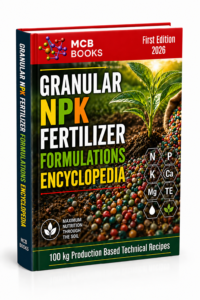
For those seeking deeper technical knowledge, real industrial formulations, and precise 100 kg production recipes, the Granular NPK Fertilizer Formulations Encyclopedia provides a comprehensive and practical resource. It is specifically designed for fertilizer manufacturers, product developers, and entrepreneurs who want to produce high-quality granular NPK fertilizers for commercial agriculture.