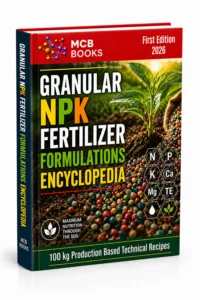
Granular NPK fertilizers are among the most important plant nutrition products used in modern agriculture. These fertilizers provide nitrogen, phosphorus, and potassium in balanced proportions to support healthy plant growth, strong root development, flowering, fruit formation, and improved crop quality. For fertilizer manufacturers, agricultural entrepreneurs, technical specialists, investors, and researchers, producing high-quality granular NPK fertilizer requires accurate formulations, suitable raw materials, controlled manufacturing processes, and reliable quality standards.
The GRANULAR NPK FERTILIZER FORMULATIONS ENCYCLOPEDIA is designed as a practical technical guide for anyone interested in commercial granular NPK fertilizer production. The book contains useful information about fertilizer formulations, raw materials, production methods, product specifications, manufacturing stages, and application areas. It can help readers understand how different NPK ratios are created and how raw materials influence the final fertilizer quality.
Commercial granular NPK fertilizer production may involve raw materials such as urea, ammonium sulfate, monoammonium phosphate, diammonium phosphate, potassium chloride, potassium sulfate, fillers, binders, coating agents, and micronutrients. The selection of these materials depends on the target nutrient ratio, crop requirements, production technology, and market expectations. Popular fertilizer grades such as NPK 15-15-15, NPK 20-10-10, NPK 12-12-17, NPK 10-20-20, and NPK 8-24-24 can be produced for different agricultural applications.
The manufacturing process generally includes raw material preparation, weighing, mixing, granulation, drying, cooling, screening, coating, quality control, and packaging. Every stage has an important effect on granule size, hardness, moisture content, nutrient uniformity, dust formation, caking resistance, storage stability, and spreading performance. Incorrect raw material ratios or unsuitable process conditions may reduce product quality and cause production losses.
The GRANULAR NPK FERTILIZER FORMULATIONS ENCYCLOPEDIA provides structured technical information that can support laboratory trials, pilot-scale production, product development, and commercial manufacturing. It is suitable for fertilizer companies, agricultural chemical manufacturers, agricultural engineers, formulation specialists, production managers, raw material suppliers, researchers, consultants, and entrepreneurs planning to establish a fertilizer production facility.
A professional formulation guide can also help producers develop different fertilizer grades, improve product consistency, reduce formulation mistakes, and expand their commercial product portfolio. Understanding the function of each raw material makes it easier to modify nutrient ratios and create crop-specific fertilizer products for cereals, vegetables, fruits, greenhouse plants, field crops, and industrial agriculture.
The GRANULAR NPK FERTILIZER FORMULATIONS ENCYCLOPEDIA: COMMERCIAL PRODUCTION FORMULAS AND MANUFACTURING GUIDE is a valuable resource for anyone who wants to learn more about granular fertilizer manufacturing or enter the commercial fertilizer market. With practical formulations, production-focused technical guidance, and detailed raw material information, the book can support the development of reliable, high-quality, and marketable granular NPK fertilizer products.