 The production of commercial microbial biopesticides requires much more than growing a beneficial microorganism. A successful product must pass through several carefully controlled stages, including fermentation, microbial biomass or spore preparation, formulation, stabilization, quality control, filling, and packaging. Each stage directly affects microbial viability, product stability, shelf life, application performance, and commercial quality.
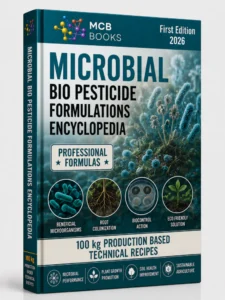
The MICROBIAL BIO PESTICIDE FORMULATIONS ENCYCLOPEDIA provides practical technical guidance for manufacturers interested in developing microbial crop protection products for professional and industrial agriculture.
The first major stage is microbial fermentation or cultivation. Depending on the microorganism, production may involve submerged liquid fermentation, solid-state fermentation, or another controlled biological growth system. Bacterial microorganisms such as Bacillus thuringiensis and Bacillus subtilis are commonly produced using controlled fermentation processes, while fungal microorganisms such as Trichoderma, Beauveria bassiana, and Metarhizium species may be produced through liquid or solid cultivation systems.
During fermentation, parameters such as temperature, pH, aeration, agitation, nutrient composition, incubation time, dissolved oxygen, and contamination control must be carefully managed. The objective is to obtain a high-quality microbial culture containing sufficient viable cells, spores, or other biologically active material. Poor process control may result in low microbial concentration, contamination, reduced biological activity, or inconsistent production batches.
After microbial cultivation, the active biological material may require harvesting and concentration. Depending on the formulation type, microbial cells, spores, biomass, or fermentation products can be separated, concentrated, filtered, centrifuged, dried, or incorporated directly into a suitable formulation system. The selected processing method should minimize stress on the microorganism and preserve biological activity.
The next stage is microbial biopesticide formulation. A commercial product generally contains not only the active microorganism but also compatible carriers and functional formulation ingredients. These may include fillers, wetting agents, dispersing agents, suspending agents, stabilizers, protective materials, anti-caking agents, moisture-control agents, oils, rheology modifiers, and other processing aids.
Formulation technology depends heavily on the final product form. Microbial biopesticides can be developed as liquid concentrates, suspension formulations, wettable powders, water-dispersible powders, oil dispersions, granules, and other carrier-based products. Each system requires different processing conditions and raw materials.
Stabilization is one of the most critical stages in microbial biopesticide production because the active component is biological and may remain sensitive to environmental conditions. High temperatures, excessive moisture, unsuitable pH, oxidation, ultraviolet radiation, and incompatible formulation ingredients can reduce microbial viability. Stabilizers and protective materials may therefore be used to help preserve biological activity throughout manufacturing, storage, transport, and application.
Moisture management is especially important in dry microbial formulations. Excessive moisture may reduce storage stability or encourage unwanted microbial growth, while excessively harsh drying conditions may damage spores or cells. Drying parameters must therefore be carefully optimized according to the microorganism and formulation technology.
For liquid formulations, manufacturers must pay attention to sedimentation, phase separation, viscosity, microbial stability, and redispersibility. The product should remain sufficiently uniform during storage and should be easy to mix before application. Suitable suspending and rheology-modifying agents can help control the physical stability of the system without damaging the biological active material.
Quality control should be performed throughout the production process. Important parameters may include viable cell or spore count, microbial purity, contamination level, germination rate, biological activity, pH, moisture content, particle size, dispersibility, suspension stability, viscosity, and storage stability. Batch-to-batch consistency is especially important for commercial microbial products.
The final production stage is filling and packaging. Packaging materials should be selected according to the sensitivity of the microbial formulation. Products may require protection from excessive moisture, oxygen, heat, or light. Appropriate container size, sealing quality, storage instructions, production identification, and shelf-life information are also important elements of a professional commercial product.
Storage conditions can significantly affect microbial biopesticide quality. Manufacturers should establish appropriate temperature and humidity requirements and conduct stability testing to determine realistic shelf-life specifications. Packaging and storage should work together to protect the microorganism until the product is applied in the field.
The MICROBIAL BIO PESTICIDE FORMULATIONS ENCYCLOPEDIA brings together practical information on fermentation, formulation technology, stabilization systems, quality control, and packaging methods. It is designed for biopesticide manufacturers, agricultural input companies, R&D departments, formulation specialists, biological control companies, entrepreneurs, and industrial producers.
Understanding the complete microbial biopesticide production process allows manufacturers to transform selected microorganisms into stable and commercially usable agricultural products. Proper control of fermentation, formulation, stabilization, and packaging provides the technical foundation required for consistent quality, improved shelf life, and successful professional microbial biopesticide manufacturing.