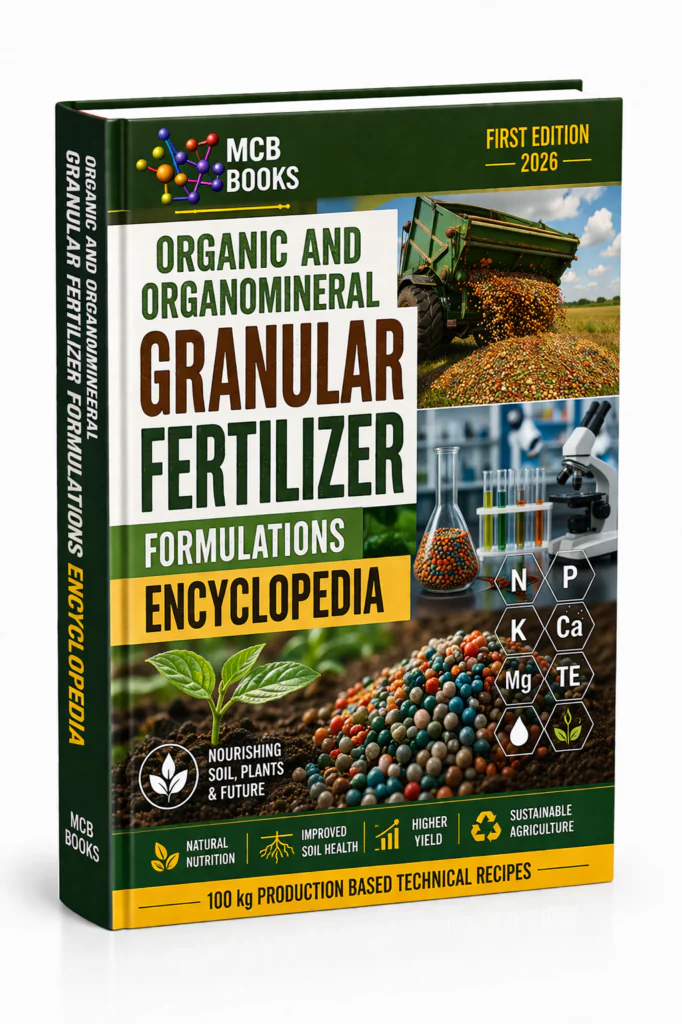
Commercial fertilizer production requires much more than simply combining nutrient sources. Successful manufacturing depends on correctly designed formulations, suitable raw materials, controlled production processes, consistent quality standards, and an understanding of how each ingredient influences the final product. For companies planning to manufacture organic and organomineral granular fertilizers, access to practical formulation and production information […]
Tag Archives: granular fertilizer production
Micronutrient-enriched organomineral granular fertilizers are developed to provide plants with essential trace elements while combining the nutritional benefits of mineral fertilizers with organic matter. Iron, zinc, manganese, and boron are required by plants in relatively small quantities, but deficiencies of these nutrients can significantly affect plant development, crop productivity, and product quality. For this reason, […]
The quality and performance of organic and organomineral granular fertilizers depend strongly on the selection of appropriate raw materials. Each ingredient used in a fertilizer formulation has a specific purpose, such as supplying nutrients, increasing organic matter, supporting granulation, improving physical stability, or enhancing the handling characteristics of the final product. Understanding these raw materials […]
Granular NPK fertilizer ratios indicate the percentages of nitrogen, phosphorus, and potassium contained in the finished product. Understanding these ratios is essential for fertilizer manufacturers, agricultural engineers, farmers, researchers, and entrepreneurs who want to select or produce suitable plant nutrition products. Different crops and growth stages require different nutrient balances, which is why commercial fertilizer […]
Granular NPK fertilizers are among the most traded agricultural inputs worldwide, and export-oriented production requires more than just standard formulations. Manufacturers targeting international markets must combine agronomic performance, strict quality standards, regulatory compliance, and competitive pricing. This guide explains how to design and produce granular NPK fertilizers that meet global market expectations and succeed in […]
Granulation is the core step that transforms fine fertilizer powders into durable, free-flowing granules suitable for modern agriculture. In NPK fertilizer production, advanced granulation techniques are essential for achieving consistent particle size, high mechanical strength, low dust levels, and optimal nutrient distribution. As the fertilizer industry becomes more competitive, manufacturers are increasingly adopting advanced technologies […]
Industrial NPK fertilizer manufacturing is a highly engineered process that transforms fine nutrient powders into durable, free-flowing granules suitable for large-scale agricultural use. This transformation—from powder to granule—is critical because granulated fertilizers offer better handling, reduced dust, improved nutrient distribution, and compatibility with mechanical spreading equipment. For manufacturers, mastering this process is the key to […]
Granular NPK fertilizers are essential tools in modern agriculture, providing plants with the three primary nutrients required for healthy growth: nitrogen (N), phosphorus (P), and potassium (K). Understanding how these fertilizers are formulated—both in terms of ingredients and ratios—is critical for manufacturers, agronomists, and agricultural entrepreneurs who want to produce effective and marketable products. At […]
Producing high-quality granular NPK fertilizer is essential for meeting the demands of modern agriculture, where farmers expect consistent performance, efficient nutrient delivery, and easy application. For manufacturers, success depends on combining the right raw materials, optimized formulation strategies, and controlled production processes to achieve strong, uniform granules with reliable agronomic results. The first step in […]
Granular NPK fertilizer production technology is a cornerstone of modern fertilizer manufacturing, enabling producers to deliver balanced, efficient, and easy-to-apply nutrient systems for commercial agriculture. The success of any granular NPK product depends on two key factors: the correct selection of raw materials and the use of appropriate formulation and granulation methods. When these elements […]
Granular NPK fertilizer production is a complex industrial process that requires precise control over raw materials, formulation, and processing conditions. Even small mistakes can lead to poor granule quality, inconsistent nutrient content, storage problems, and customer complaints. For manufacturers, identifying common production errors and understanding how to prevent them is essential for maintaining product quality […]
OVERVIEW Chemical fertilizers are industrially produced nutrient products designed to supply plants with essential elements such as nitrogen, phosphorus, potassium, secondary nutrients, and micronutrients. The goal of chemical fertilizer manufacturing is to create stable, efficient, and easy-to-apply formulations that meet the nutritional needs of crops under different soil and climate conditions. This article provides a […]
INTRODUCTION Liquid complex fertilizer making and granular compound fertilizer manufacturing are two important production approaches used in modern fertilizer industry. Both methods aim to supply multiple essential nutrients in balanced and efficient forms. Understanding the principles behind liquid complex fertilizer making and granular compound fertilizer manufacturing helps improve fertilizer performance, nutrient efficiency, and crop productivity. […]
INTRODUCTION Chemical fertilizer making recipe refers to the systematic formulation and production of mineral fertilizers designed to supply essential nutrients required for plant growth. Chemical fertilizers are manufactured using specific raw materials, controlled ratios, and standardized processes to ensure nutrient availability, stability, and efficiency. Understanding the chemical fertilizer making recipe is fundamental for producing high-quality […]
INTRODUCTION Solid (granular) micronutrients fertilizers are designed to supply essential trace elements in stable, soil-applied form to correct micronutrient deficiencies and support balanced plant nutrition. These fertilizers provide long-term availability of micronutrients and are commonly used in field crops, orchards, and horticulture. Proper formulas, composition, and production methods ensure uniform nutrient distribution and agronomic effectiveness. […]
The topic of How to Make Fertilizers is fundamental in agricultural chemical production. Understanding Fertilizer Formulations and Methods allows manufacturers to produce high-efficiency nutrient products tailored to different crops, soil types, and climatic conditions. Modern agriculture requires scientifically balanced fertilizers that provide essential macro and micronutrients while ensuring high solubility, stability, and cost efficiency. This […]